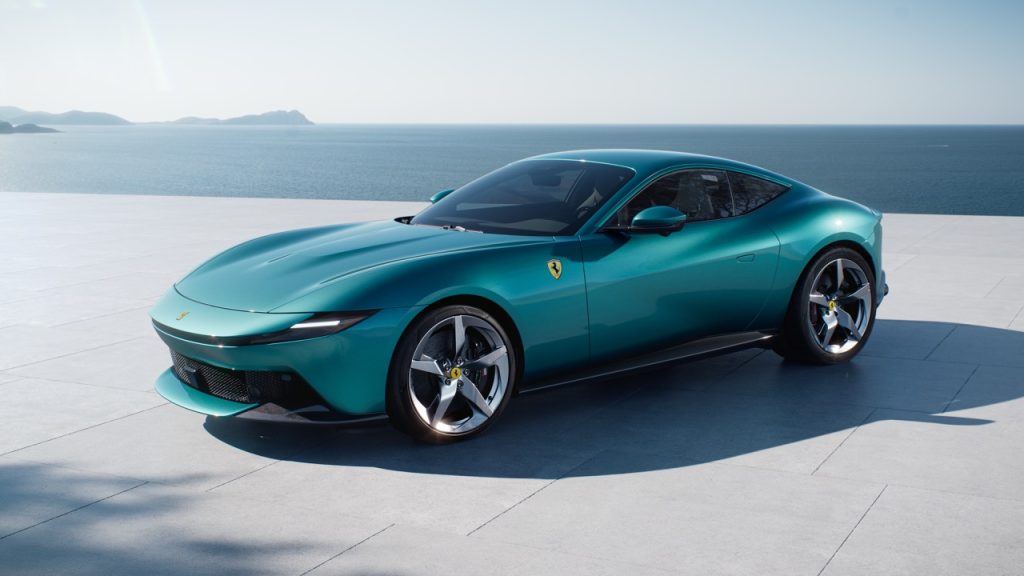
Ferrari doesn’t sit still for long. Every new model builds on what came before, while pointing to where the Italian marque is heading next. In 2026, that direction is the Ferrari Amalfi, a front-mid-engine V8 2+ coupé that replaces the Roma in the Prancing Horse lineup.
Unveiled in Kuala Lumpur, the Amalfi arrives at a time when expectations around performance cars are changing. Speed remains important, but it’s no longer the only measure of a good sports car. Usability, comfort, and how it fits into everyday routines matter just as much.
From traffic jams to interstate trips, modern drivers expect a vehicle that can handle daily use, while still delivering the performance needed when the road opens up. Ferrari does this by taking the concept of a Grand Tourer and repositioning it for a more contemporary reality.
The Amalfi runs on a 3.9 litre twin-turbo V8, part of the acclaimed F154 engine family, producing 640 cv. Power builds up gradually to 7,500 rpm, with a redline that now extends to 7,600 rpm. This allows the engine to deliver performance across the rev range, rather than in short bursts.
The numbers are clear: 0 to 100 km/h in 3.3 seconds, 0 to 200 km/h in 9.0 seconds, and a top speed of 320 km/h. These figures are exactly what you would expect from a luxury sports car brand like Ferrari. But what matters most is how accessible that performance feels.
Ferrari has reworked the turbocharging system, allowing independent control of each turbo. This boosts throttle response, reducing delay when you press the accelerator. In practice, this means smoother overtakes and less hesitation in stop-and-start traffic.
The eight-speed dual-clutch transmission complements this setup. At lower speeds, it delivers smoother gear changes. Push harder, and it tightens up, delivering quicker, more direct gear shifts. The transition between the two is seamless.
In city traffic, the car remains controlled and predictable. On the open road, it responds without hesitation, supported by a redesigned exhaust sound. It retains the signature V8 tone, but with a new silencer layout that meets stricter noise-emission regulations in residential areas.
With the Side Slip Control system, the Amalfi links its dynamic features, including torque and stability controllers, into a single network. These communicate in real time, allowing the car to respond more consistently to your inputs, such as steering and acceleration. Whether you’re driving on smooth highways or less-than-perfect roads, the car feels much more predictable.
Brake-by-wire technology plays a role here as well. It enhances stopping power while reducing pedal effort. The updated ABS Evo system adjusts braking force based on grip levels at each wheel. Grip estimations read road conditions 10 per cent faster, even on low-traction surfaces. This is especially useful during the monsoon season, helping the car stabilise in harsh weather.
A full suite of driver assistance features is also included to support everyday driving. Adaptive cruise control, lane keeping, and emergency braking operate quietly in the background, stepping in only when needed. An optional front lifter raises the car by 40 mm at low speeds, making it easier to deal with pesky speed bumps, steep ramps, or basement parking entrances.
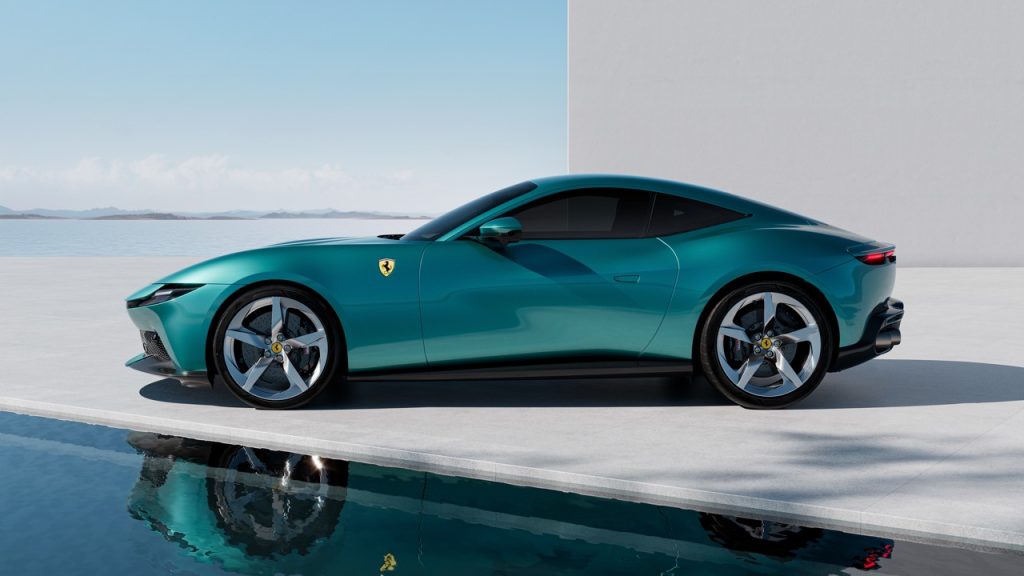
At first glance, your attention will go straight to the launch colour. Ferrari calls it Verde Costiera, a teal-green shade inspired by the Mediterranean Sea along the Amalfi Coast. It reflects light across the car’s surface, highlighting its smooth and sculpted shape. It’s a colour that will certainly turn heads, and also subtly changes depending on the environment.
Now, onto the shape. The Amalfi carries the proportions of a traditional Ferrari 2+ coupé berlinetta. The proportions remain sleek, monolithic, and balanced. A long bonnet, a set-back cabin, and a compact rear reinforce its front-mid-engine layout. From the side, the wedge-shaped profile gives the vehicle a sense of movement, even when stationary, due to its forward stance.
The front ditches the traditional grille. Instead, a floating body-coloured wing defines the nose. Headlights and sensors are integrated into a darker recessed section to keep the design sporty. At the rear, it tapers into a compact shape, with hidden lighting elements that echo older Ferrari models. The tail lights sit within graphic cuts, rather than standing out as a separate technical element. Meanwhile, the diffuser remains exposed, making its aerodynamic function clear.
Active aerodynamics are also built into the structure. Airflow is guided through the vehicle’s ducts, diffusers, and underbody elements to reduce drag and improve efficiency. The development process combined simulation with wind tunnel testing to refine the design into a functional component.
The rear mobile wing automatically adjusts between three settings: low drag, medium downforce, and high downforce — depending on speed and driving conditions. At high speeds, it can generate an extra 110 kg of downforce with minimal impact on drag.
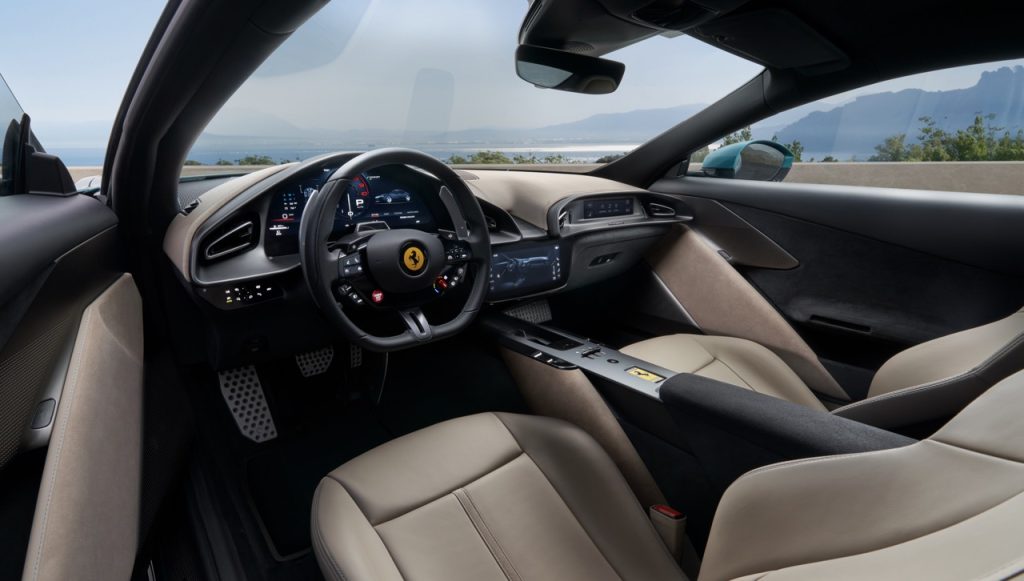
The interior adopts a dual-cockpit layout, separating driver and passenger into two connected spaces. This design creates a more focused driving position, while maintaining a sense of openness across the cabin.
There’s also a clear shift towards tactile controls and interactions. The Amalfi’s steering wheel reintroduces physical buttons, along with Ferrari’s signature start button, which is destined to delight fans.
But there are still digital displays: three to be exact. A 15.6 inch instrument cluster for driving and vehicle data. A 10.25 inch central touchscreen for multimedia and climate control settings. And an 8.8 inch display gives your passenger key information about the drive, including engine revs and G-forces. Although we’d expect that most passengers would be itching to get behind the wheel themselves.
The Amalfi’s look may be divisive; the colour won’t be to everyone’s taste. But for sports car enthusiasts looking for a car that’s also a comfortable town ride, the Amalfi certainly merits a closer look. The road to Sepang just started feeling a little more like the Italian coastline.

Esquire Malaysia
©2026, Heart Media Pte Ltd
