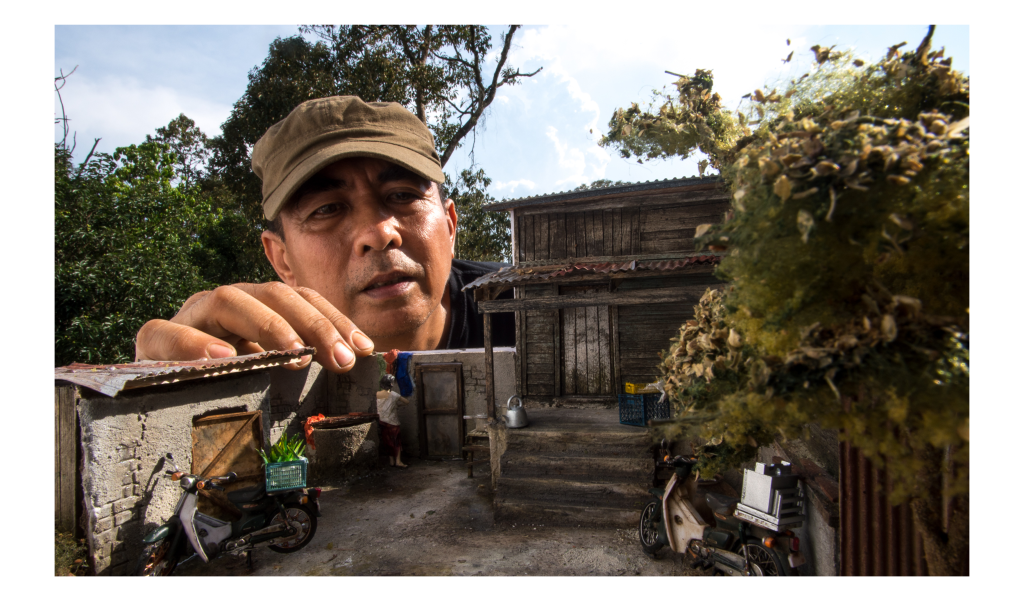
For nearly four decades, Eddie Putera has sought one thing: telling stories through visuals. He’s spent that time behind the camera as a photographer and videographer, creating work for production houses and films. Along the way, he’s also played instruments and explored the latest technology.
For the past decade, he has found his calling in building hyper-realistic miniatures, which have appeared in commercials and films, and have been purchased by collectors. Now 59, he still carries the wonder of a young heart, constantly discovering something new to learn and explore in pursuit of his inner curiosity.
That spirit has now landed him in Apple’s Here’s to the Dreamers, returning for its fourth year to spotlight some of Southeast Asia’s most inspiring creatives. We sat down with Eddie Putera to talk about miniature-making, his values and what’s next for him.
ESQUIRE MALAYSIA: How did you get into miniature making?
EDDIE PUTERA: I retired from my main source of income about 10 years ago, and I thought, “Wow, it’s time for me to do the things I couldn’t do when I was younger.” One of those things was simply playing with toys.
I started searching for model kits. At the time, there weren’t many cars, tanks or aeroplanes available, but Gundam was becoming very popular. I started buying the kits and putting them together piece by piece. That’s how the hobby began.
ESQ: Was it difficult when you first started making miniatures?
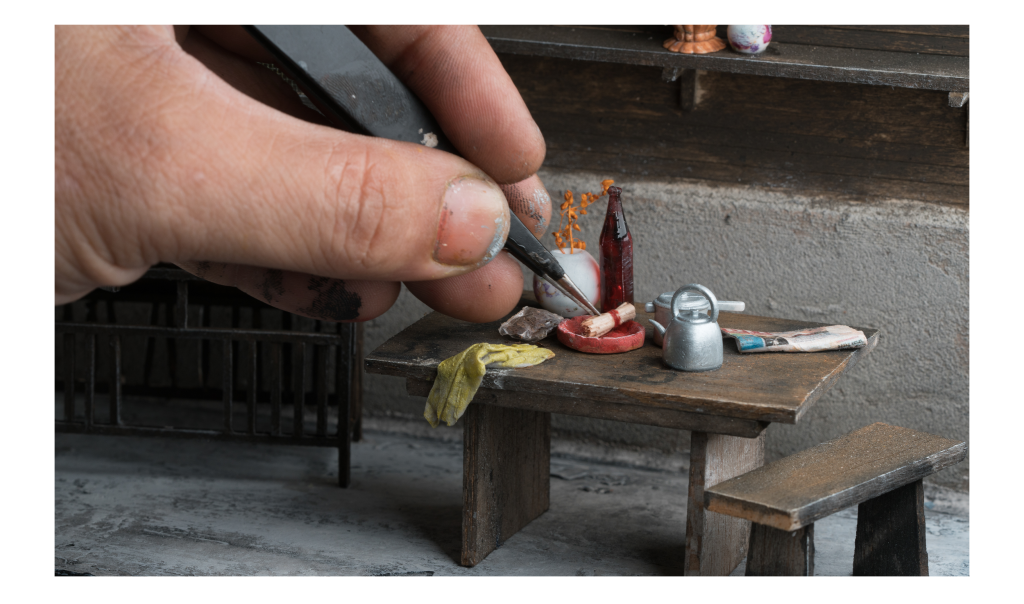
EP: The hardest part was figuring out how to physically make certain things.
For example, how do you make a wooden door? When I first started, there weren’t many references available. I had to go online and look for tutorials. There were only a few tutorials on YouTube, so that was my first source of information. Most of them came from Europe, Thailand or Japan. The challenge was adapting those techniques to our own geography.
ESQ: A lot of the spaces you recreate are ordinary places such as an old shopfront, a roadside stall and a kampong house. What makes a place worth recreating?
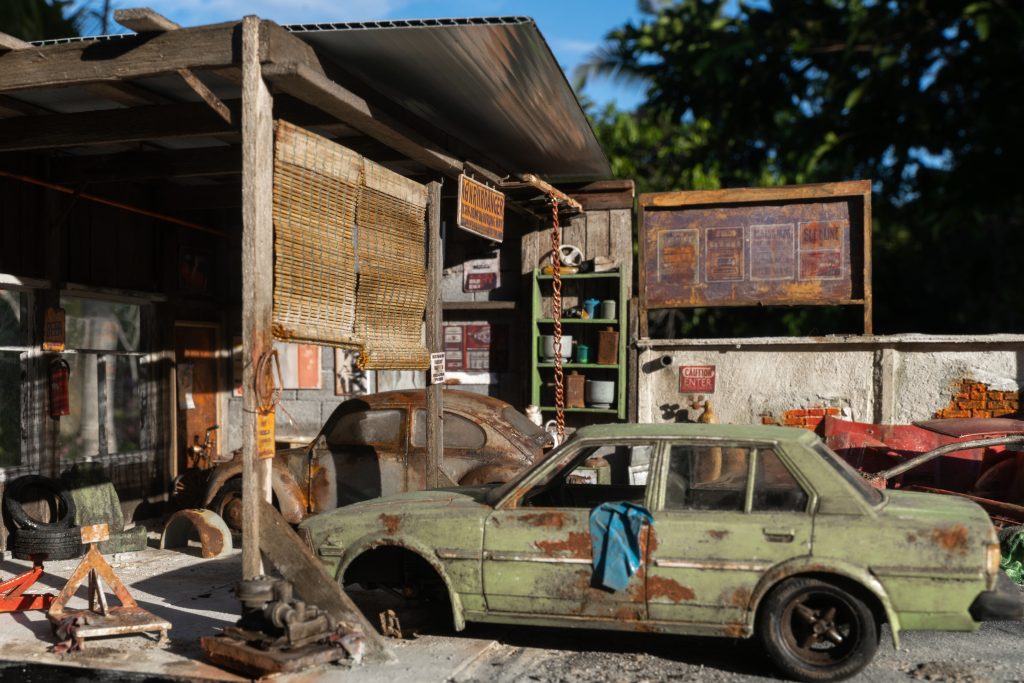
EP: I have a lot of passions, and one of them is travelling. But when I travel, I don’t really go to touristy places. I like exploring the back lanes—the places where people actually eat, work and live.
When I’m there, I start noticing the deterioration of materials such as the rust, the moss growing on the walls and the cracks in the buildings. To most people, those details might just look like signs of a rundown place. But I see something that can be turned into something beautiful.
ESQ: How long does it usually take you to finish a project, and what happens when you’re not in the zone? How do you get yourself back into it?
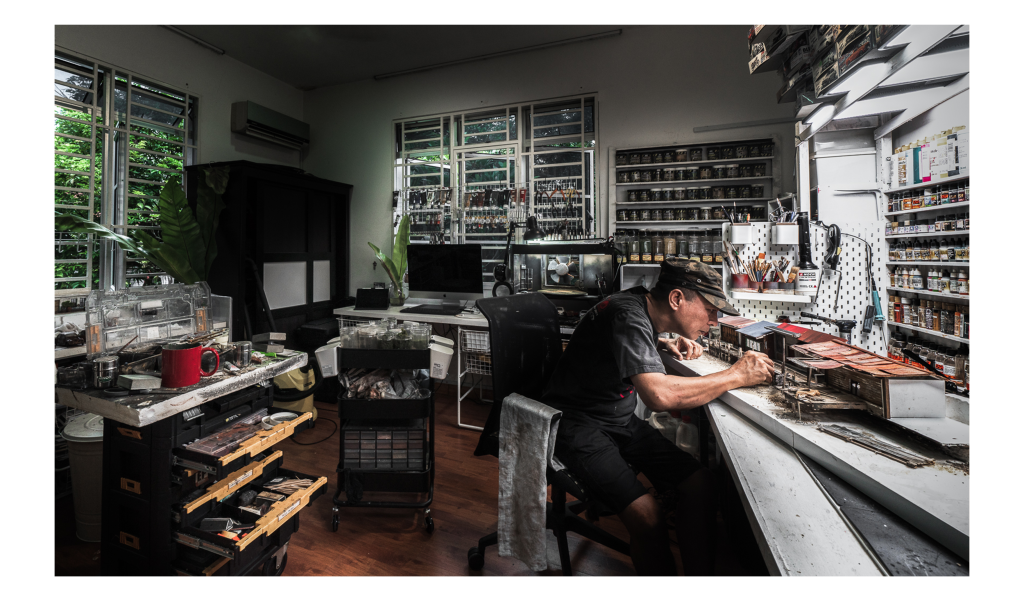
EP: It depends on whether I can get into that zone. That’s why I have a lot of other passions. If I’m creatively blocked, I might stay away from this studio for a day or two. I’ll spend time in my music room or go outside and work in the garden. With art, you can’t force it. You have to take it slowly, and eventually, it comes back to you.
ESQ: Of everything you’ve made, is there one piece that stays with you?
EP: There’s one particular project I did for a friend that has always stayed with me. His father had built their family home, but the house isn’t there anymore. He wanted to give his father something special for his 80th birthday, so he gave me some photographs and I recreated the house as a miniature.
When he presented the gift, he covered it with a cloth and brought the model over to his father. When they revealed it, it brought tears to his father’s eyes.
No money can buy that. From then on, I thought, “This is what I will do.” The big commercial projects can buy me a lot of things, but they don’t give me that feeling. They don’t make you smile for days.
ESQ: You’ve been experimenting with technology for years, using a 3D printer to produce models, and working with AI to sketch your designs. What is it about technology that has kept you interested all these years?
EP: When I went to university, that’s when I first came across the first Macintosh SE. It was this small, little machine, and that was the start of my journey with Mac, which has continued until now. For some people, technology can be intimidating. But for me, it’s interesting.
To me, AI is just another tool. I’ve been lucky enough to live through different phases of technological development. When I was in school, my teachers were still using typewriters. Then computers came along, and people in the writing community began questioning whether writing would still be pure if everything could be automated.
AI can help me speed up some of the research process, but the creative direction still comes from me. It can help me with the sketches, but it can’t physically cut the cardboard for me. It can’t go to the shop and buy the materials.
That’s where human intervention in my creative process comes in. AI can be part of the workflow, but the idea, the decisions and the physical act of creating still belong to me.
ESQ: You’ve spent your career moving from one creative discipline to another and continuing to learn. What does being a “Dreamer” mean to you at this stage of your life?
EP: For me, being a Dreamer is about having the opportunity to inspire more people to become dreamers themselves. I hope this platform allows me to encourage more people, especially the younger generation, to pursue their own dreams.
ESQ: After everything you’ve built—both literally and creatively—what is something you’re still curious enough to learn or create next?
EP: I’d love to go into coding. That was inspired by the other Dreamers as well. With AI, the learning process can be much faster. I haven’t had the chance to sit down and properly learn coding, but I think that’s what I want to pursue next—coding and electronics.
ESQ: What are your goals moving forward with miniatures?
EP: I’m a history buff, and I’ve been studying history all my life. I live in Kuala Lumpur, and what I hope to do is to walk through the history of Kuala Lumpur, from its beginnings to what it is today, through miniature. It’s a big task, and it might not happen. But that’s my dream—to tell the history of Kuala Lumpur through my miniatures.

Esquire Malaysia
©2026, Heart Media Pte Ltd
